

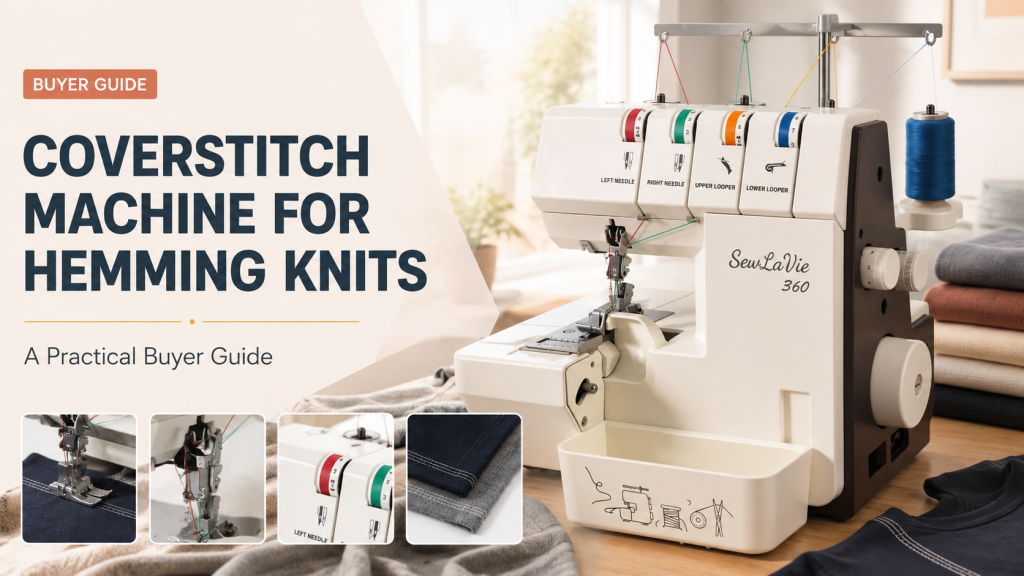
A coverstitch machine for hemming knits creates the familiar parallel needle lines seen on T-shirts and activewear while loopers cover the raw edge underneath. Its value comes from stretch, a clean commercial appearance, and faster repeated hemming—not from replacing every function of a sewing machine or serger. Buyers should compare fabric handling, differential feed, seam widths, free-arm access, threading, low-speed control, and how easily finished hems can be released without unraveling.
Is A Coverstitch Machine For Hemming Knits Worthwhile?
The machine is most useful for makers who sew T-shirts, leggings, children’s knitwear, dancewear, or small production runs. It can produce two- or three-needle cover hems and, on many models, a chain stitch. It does not trim the edge like a serger, so the hem allowance normally must be prepared and guided accurately. For this decision, professional knit hems is useful context: The commercial look depends on even needle lines, covered raw edges, balanced tension, and a hem that stretches without tunneling.
Evaluate changeover time as part of the decision. Some users keep a serger and coverstitch threaded separately to avoid repeated conversion, while combination machines save space but require mode changes. The better workflow depends on project volume, room, budget, and tolerance for rethreading. For this decision, twin needle alternative is useful context: A domestic twin needle can imitate two top lines, but bobbin zigzag, tension, stretch, and tunneling differ from a true looper stitch.
Features That Make Knit Hemming Easier
Differential Feed And Pressure Control
Soft knits can wave as the hem passes under the foot. Differential feed helps balance fabric movement, while adjustable pressure can reduce stretching or marking. Test settings at the actual hem direction because cross-grain behavior differs from lengthwise seams. For this decision, cover hem machine is useful context: This dedicated machine forms cover stitches without a trimming knife and is designed around hemming and chain-stitch operations.
Needle Spacing And Stitch Configurations
Common options include narrow and wide two-needle cover hems, three-needle cover stitch, and chain stitch. Confirm the available widths suit neckbands, sleeves, leggings, and decorative topstitching. More configurations are useful only when changeover remains practical. For this decision, stretch garment finishing is useful context: A successful finish must recover with the fabric, stay flat, and remain comfortable at cuffs, necklines, waistbands, and hems.
Free-Arm And Garment Access
Sleeve cuffs and narrow children’s garments can be difficult on a flat bed. A usable free arm or compact front area improves circular hemming. Check how much fabric must pass around the machine and whether the presser foot lifts high enough at crossed seams. For this decision, Brother coverstitch is useful context: Review the exact model’s stitch configurations, threading, accessories, and fabric recommendations instead of relying on the brand category.
Threading, Release, And Finishing
Clear thread paths, accessible looper controls, color guides, and useful threading aids reduce setup time. Ask how to end a seam, pull threads to the underside, and secure them without accidental unraveling. Practice removing a finished garment from the machine.
Attachments And Seam Guidance
Clear feet, center guides, hem folders, elastic feet, and binding attachments can improve consistency. Accessory cost and availability vary greatly. A simple marked guide may be more useful than an expensive binder if project widths change often. For this decision, chain stitch machine is useful context: A single-needle chain stitch is useful for basting, decorative work, and selected construction, but it can unravel if the end is not secured.
Run A Complete Knit-Hem Audition
- Prepare identical hems in lightweight jersey, medium cotton knit, and a stretch athletic fabric.
- Thread the machine from the beginning and install the manufacturer-recommended needles.
- Test narrow and wide two-needle configurations using the same folded hem depth.
- Sew across a side-seam intersection slowly and compare stitch length and feeding.
- Stretch each sample firmly, release it, and inspect recovery, tunneling, skipped stitches, and looper coverage.
- Practice ending, releasing, and securing the seam three times without cutting threads accidentally.
- Try a circular sleeve or leg opening to judge free-arm access and control.
A demonstration on a stable dealer fabric is not enough. The machine should be judged on the lightest, stretchiest, and bulkiest knit constructions you expect to sew. For this decision, activewear sewing is useful context: Highly elastic performance fabrics require suitable needles, differential feed, thread balance, and recovery testing after stretching.
Coverstitch Versus Domestic Twin Needle
| Decision point | Coverstitch | Twin needle on sewing machine |
|---|---|---|
| Underside formation | Looper covers raw edge | Bobbin zigzag |
| Stretch and recovery | Designed for knit hemming | Depends on machine and settings |
| Setup cost | Dedicated machine and space | Lower when compatible |
| Repeated hems | Fast once threaded | Requires sewing-machine changeover |
| Decorative flexibility | Cover and chain configurations | Broader domestic stitch options |
Causes Of Tunneling And Skipped Hem Stitches
- Using universal needles instead of the system recommended for the knit.
- Stretching the garment while guiding it around the bed.
- Ignoring differential feed when the hem becomes wavy.
- Crossing a bulky side seam at full speed.
- Cutting thread tails before learning the correct seam-release method.
When a problem appears on only one fabric, save the sample and adjust feeding, pressure, needle, thread, and tension systematically. Avoid changing every tension control at once. If you want a broader comparison before buying, review Brother 2340CV product page and compare its guidance with the setup discussed in this article.
Build An Efficient Hemming Station
Press or mark the hem depth consistently, trim the raw edge evenly, and use a guide so the needles catch the intended allowance. Test the start and end method before sewing the garment. For circular hems, plan the overlap where it will be least visible and approach the beginning stitches accurately. For a more specific setup check, use Bernette coverstitch option to compare compatibility details, fabric behavior, or attachment limits before you order.
Keep common thread colors on cones, label successful settings by fabric, and clean lint around the looper area frequently. When switching between cover and chain configurations, follow a written sequence and store removed needles safely. Consistency comes from repeatable preparation as much as from the machine. When you need a product example or a supporting tutorial, Serger versus sewing machine guide gives you another reference point that fits naturally with this topic.
Choose A Coverstitch Machine For Hemming Knits Around Repeated Workflow
A coverstitch machine for hemming knits is a practical investment when stretch garments are a regular part of sewing and a dedicated looper finish improves speed and consistency. Compare feeding, access, threading, seam release, configurations, and accessories on real fabrics, then choose the model that makes the entire hemming process repeatable. A coverstitch machine for hemming knits earns its space when it produces flat, flexible hems more reliably than your current method. For manufacturer-level technical detail, also review Brother’s 2340CV model information before changing settings, buying accessories, or troubleshooting a difficult seam.
Frequently Asked Questions
Does a coverstitch machine cut fabric like a serger?
No. A typical coverstitch does not trim the raw edge. The hem allowance is prepared and the looper threads cover it underneath as the needles stitch from above.
Can I use a twin needle instead of buying a coverstitch?
Yes for many occasional hems. A twin needle is less expensive, but the underside, stretch, tunneling behavior, and production workflow differ from a true cover stitch.
Why does my coverstitch skip at the side seam?
The abrupt thickness can reduce feeding or deflect the needle. Use fresh correct needles, slow down, level the foot when possible, and test pressure and differential feed.
Is a combination serger-coverstitch machine better?
It saves space and may cost less than two premium machines, but mode conversion can interrupt workflow. Dedicated machines are convenient for frequent alternating operations.
What thread is used in a coverstitch machine?
Quality serger thread is common in the looper and needles, but specialty decorative thread may be used where the manual permits. Always test tension, stretch, and needle compatibility.
