

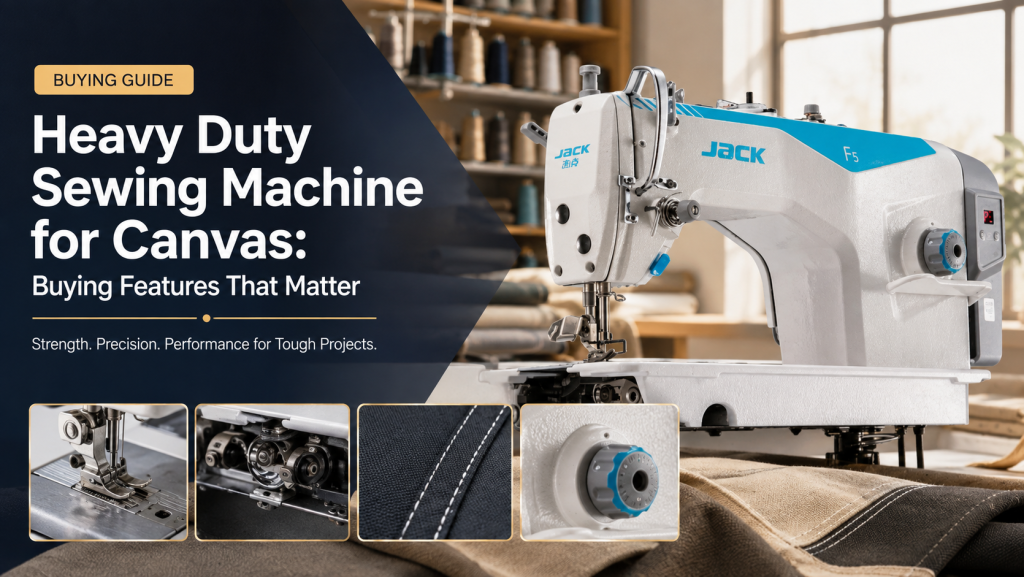
A heavy duty sewing machine for canvas must do more than punch through one flat sample. Real canvas projects include folded hems, webbing, bound edges, boxed corners, zippers, and seam intersections that change thickness abruptly. The correct machine should feed those layers without forcing, start under control, accept an appropriate needle and thread combination, and leave balanced stitches on both sides. Material coating and weave can matter as much as nominal weight.
Choose A Heavy Duty Sewing Machine For Canvas By Seam Type
Canvas ranges from flexible cotton duck to stiff coated outdoor fabric. A home machine that handles a tote bag may struggle with a multilayer boat-cover corner or webbing reinforcement. Count the maximum folded layers and include binding, zipper tape, and seam allowances when preparing the test stack. For this decision, canvas sewing machine is useful context: A suitable model should feed and stitch the project’s actual layer stack, not merely penetrate a single canvas swatch.
Also define the required thread. Heavy decorative or structural thread needs a needle eye, tension path, bobbin, hook, and take-up system designed for it. Forcing oversized thread into a domestic machine can create poor tension and damage even when the needle penetrates the fabric. For this decision, thick fabric stitching is useful context: Success requires balanced feeding, straight needle entry, correct thread formation, and controlled transitions between thicknesses.
Mechanical Features That Matter On Canvas
Controlled Penetration At Low Speed
The machine should begin slowly and continue through the dense point without needing a running start. Electronic speed limiting or a well-matched servo system can improve control. Handwheel resistance should remain smooth rather than reaching a hard stop. For this decision, heavy duty needle is useful context: Use the correct needle system and point for the fabric, selecting the smallest size that supports the thread without deflection.
Layer Feeding And Foot Options
Canvas layers can creep, especially with coatings or binding. Strong feed dogs, suitable pressure, and compatible even-feed or walking options improve alignment. For repeated heavy work, an industrial needle-feed or compound-feed mechanism may be more appropriate. For this decision, strong feed system is useful context: For demanding layers, walking or compound feed can control top and bottom movement more effectively than basic drop feed.
Foot Lift And Clearance
High lift helps position bulky hems, but clearance alone does not prove sewing capacity. The needle bar, hook, feed system, motor, and frame must still form a stitch through the stack. Test sewing rather than judging how much material fits under a raised foot. For this decision, upholstery sewing at home is useful context: Occasional cushions and light décor differ from structural upholstery, dense piping, leather, and repeated production work.
Needle, Thread, And Bobbin Limits
Check the manual’s approved needle system, maximum size, and thread recommendations. A larger bobbin reduces interruptions on long seams, but correct tension and hook clearance are essential. Use quality thread appropriate to the project’s weather and abrasion exposure.
Frame, Table, And Serviceability
A stable machine and supported work surface prevent the project’s weight from steering the seam. Metal internal structure can improve rigidity, but external material claims do not reveal every component. Parts availability and local adjustment support matter for sustained heavy use. For this decision, motor power sewing machine is useful context: Useful power is demonstrated by smooth low-speed sewing through the test seam, not by wattage or speed claims alone.
Build A Realistic Canvas Test Stack
- Use the same canvas weight and coating planned for the project.
- Create flat two-layer, folded four-layer, webbing-reinforced, and crossed-seam samples.
- Install the approved needle and thread, then set a moderate stitch length.
- Start directly on the thick section at slow speed without pulling the material.
- Sew from thin to thick and back, watching stitch length and layer alignment.
- Backstitch or secure the seam as the project requires and inspect both sides.
- Repeat the hardest sample after the machine warms up to confirm consistent performance.
Reject a setup that succeeds only when the handwheel is forced, the fabric is pulled, or the machine uses momentum to jump the seam. Those workarounds bend needles and hide an unsuitable feed or capacity problem. For this decision, durable metal frame is useful context: Internal rigidity can support alignment, but hook design, feeding, bearings, and service condition also determine long-term performance.
Match Machine Class To Canvas Work
| Canvas project | Likely machine class | Key requirement |
|---|---|---|
| Light tote bags | Capable full-size home machine | Controlled hems and stable feeding |
| Indoor cushions | Heavy-duty domestic or suitable industrial | Piping and zipper clearance |
| Outdoor covers | Industrial feed often preferable | Coated layers and long seams |
| Webbing reinforcement | Industrial walking or compound feed | Alignment and penetration |
| Occasional repairs | Tested domestic may suffice | Correct needle, thread, and seam access |
Buying Errors That Lead To Stalled Projects
- Testing only one flat fabric layer instead of the finished seam stack.
- Choosing thread too large for the machine’s tension and hook system.
- Pulling heavy canvas from behind and bending the needle.
- Letting the project hang from the table and steer the seam.
- Assuming a metal exterior or high speed automatically means heavy capacity.
When the project includes leather, thick binding, dense webbing, or many repeated seams, compare the cost of the correct industrial feed system with the cost of broken needles, poor results, and slow handling on an undersized machine. If you want a broader comparison before buying, review Heavy-duty thick-fabric guide and compare its guidance with the setup discussed in this article.
Prepare Canvas Projects For Reliable Feeding
Cut accurately, mark seam allowances clearly, and grade hidden bulk where the construction allows it. Use clips instead of pins on dense or coated areas, support the project on a large table, and plan the sewing order so the most difficult corners remain accessible. A leveling tool can help the foot cross a sudden ridge. For a more specific setup check, use Juki walking-foot machine to compare compatibility details, fabric behavior, or attachment limits before you order.
Test stitch length and tension after every change in layer count or thread. Keep the needle path clear of clips, slow down before intersections, and avoid repeated stitching in the same holes on coated fabric. After the project, remove lint and inspect the needle plate and hook area for burrs caused by deflection. When you need a product example or a supporting tutorial, Singer 4452 heavy-duty machine gives you another reference point that fits naturally with this topic.
Choose A Heavy Duty Sewing Machine For Canvas After A Realistic Seam Test
A heavy duty sewing machine for canvas is the right choice only when it feeds, penetrates, and forms balanced stitches through the project’s hardest realistic construction at a controlled pace. Match the machine class to canvas weight, coating, thread, and production frequency, and move to industrial feeding when domestic compromises become the bottleneck. A heavy duty sewing machine for canvas should handle the finished seam stack slowly and consistently, not just sew one flat layer. For manufacturer-level technical detail, also review the SCHMETZ needle-selection guide before changing settings, buying accessories, or troubleshooting a difficult seam.
Frequently Asked Questions
Can a domestic heavy-duty machine sew canvas?
Many can sew light or medium canvas projects when the layer count, needle, thread, and feeding remain within the machine’s limits. Thick coated assemblies and webbing may require industrial feed.
What needle should I use for canvas?
Use the needle system specified by the machine and a point and size suitable for the canvas and thread. Test the smallest approved size that penetrates cleanly without bending.
Why are stitches shorter on thick canvas seams?
The foot may tilt, feed contact may reduce, or the project may drag from the table. Level the foot, support the material, use suitable feeding, and slow down at the transition.
Do I need a walking-foot industrial machine?
It becomes valuable for frequent heavy, slippery, multilayer, or upholstery-style work where basic drop feed cannot keep layers aligned.
Can I use upholstery thread in a home machine?
Only if the manual supports the thread size and a compatible needle. Thread that is too large for the tension path, needle eye, bobbin, or hook can create jams and poor stitches.
