

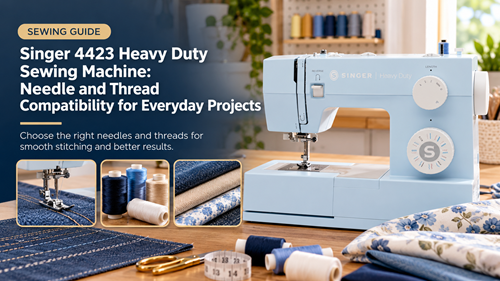
Singer 4423 heavy duty sewing machine deserves a practical workflow check before it becomes part of a regular sewing, embroidery, serging, or transport routine. This guide is written for denim sewing enthusiasts and focuses on needle and thread compatibility for everyday projects. Instead of treating settings or accessories as isolated features, the goal is to build a repeatable process that can be tested on real materials, documented, and reproduced when the next project begins.
How To Plan The Singer 4423 Heavy Duty Sewing Machine Workflow
Begin with the finished result. Write down the material, seam or design type, finished dimensions, number of layers, required accessories, and the level of repeatability you expect. For denim sewing enthusiasts, this prevents a common mistake: changing machine settings before the real project requirements are clear.
A good workflow separates preparation from diagnosis. Prepare the machine or accessory correctly, create a baseline sample, and then change one variable at a time. If several things change at once, it becomes difficult to know whether the improvement came from threading, needle choice, feeding, tension, stabilizer, foot selection, or operator technique.
Use Singer 4423 heavy duty sewing machine setup as the starting routine, then keep the same project materials and sequence long enough to tell whether a change really improves the result.
Singer 4423 Heavy Duty Sewing Machine Setup And Compatibility Checks
Match Needle Type To Fabric Behavior
Denim, woven cotton, canvas, stretch material, and coated fabric do not all need the same point style. Start with a needle intended for the fabric family, then choose the smallest size that penetrates cleanly without bending or leaving unnecessarily large holes.
Keep Thread And Needle Size In Balance
Thread that is too heavy for the needle can drag through the eye and create inconsistent tension. Thread that is too fine for the project may not give the appearance or durability you expect. The pair should feed smoothly before you change machine tension.
Test Bulky Transitions Instead Of Flat Layers
A machine can look strong on two flat layers and struggle where a hem crosses a side seam. Build a realistic sample with folds and intersections so the test shows feeding, needle deflection, foot angle, and low-speed control under the conditions that matter.
Use Presser-Foot Choice To Support Feeding
An appropriate foot can help manage multiple layers, coated surfaces, or edge control. Do not use a specialty foot to compensate for the wrong needle or thread; fix the basic combination first, then choose the foot that solves the remaining feeding problem.
Before adding fitted parts or changing the workflow, confirm Singer 4423 heavy duty sewing machine compatibility against the exact model or attachment point. Similar-looking machines and accessories can differ in clearances, bobbins, feet, hoops, motors, or electrical details.
Plan Singer 4423 heavy duty sewing machine accessories around the first projects you will actually make. Buy or prepare the items that solve a real setup problem instead of collecting extras that make the workstation harder to organize.
Build A Repeatable Project Workflow
Keep the test conditions close to the real job. Use the same fabric family, thread, needle, accessory or hoop, seam construction, and working speed whenever possible. A sample that is easier than the final project can hide the exact problem that later appears on a finished garment, gift, quilt, or customer order.
Evaluate Singer 4423 heavy duty sewing machine stitch quality on repeatable samples, not on one lucky seam or stitch-out. Compare the front and back, transitions, corners, dense areas, and the result after the fabric is handled or stretched as it will be in use.
Build Singer 4423 heavy duty sewing machine user tips into a short written checklist. A repeatable routine helps beginners and experienced users notice when a needle, thread, foot, hoop, feed setting, or preparation step changed between projects.
Turn Singer 4423 heavy duty sewing machine project guide into two or three representative samples before committing to a larger batch. Those samples reveal whether the machine, accessory, or case fits the work rather than only fitting the product description.
Save the successful setup. A short note with material, thread, needle, stitch or design setting, foot or hoop, and any special preparation turns one good result into a repeatable system. That record is especially useful when the same project returns weeks later or another person needs to reproduce it.
A Practical Test Before The Full Project
- Identify the exact fabric and number of layers in the hardest seam.
- Choose a needle designed for that fabric family and install a fresh one.
- Select thread that fits the needle eye and the intended seam appearance.
- Sew a flat sample first, then cross a folded or bulky intersection.
- Inspect both sides for skipped stitches, loops, abrasion, and uneven length.
- Record the needle, thread, stitch length, foot, and speed that gave the cleanest result.
Judge the sample after the entire process, not only while the machine is running. Check the front and back, seam or design alignment, thread balance, fabric distortion, edge condition, stretch or recovery where relevant, and how the result looks after normal handling. If a problem appears, return to the baseline and make one controlled change.
What To Check At A Glance
| Project Or Symptom | Priority Check | Warning Sign |
|---|---|---|
| Routine woven seam | Universal or fabric-appropriate needle | Avoid oversizing the needle |
| Denim repair | Jeans needle and compatible thread | Test crossed hems |
| Canvas utility seam | Strong appropriate needle | Manage bulky corners |
| Stretch project | Stretch/ballpoint as appropriate | Check skipped stitches |
Common Mistakes To Avoid
- Choosing the largest needle just because the fabric is thick
- Using decorative heavy thread before confirming basic stitch formation
- Pulling fabric from behind the presser foot
- Testing only flat layers
- Changing tension before checking threading and needle condition
These mistakes are easy to make because they can produce a usable result once and still fail on the next project. Consistency comes from controlled preparation, documented settings, and realistic samples rather than from chasing a single “perfect” number.
Troubleshoot In A Fixed Order
When the result changes, start with the simplest reversible checks: threading or installation, needle or consumable condition, material preparation, bobbin or thread path, foot or hoop fit, feeding, and the normal user-adjustable settings. Only after those checks should you consider deeper mechanical causes. This order protects the machine from unnecessary adjustment and makes service information more useful.
For persistent problems, use Singer 4423 heavy duty sewing machine troubleshooting together with the current manufacturer documentation. Record the exact symptom, material, setup, and changes already tested before making a mechanical adjustment or seeking service.
Take a photo of the sample and write down the conditions that produced it. That small record can save time when comparing a later test, asking a technician for help, or returning to a project after a long break.
Use The Singer 4423 Heavy Duty Sewing Machine With A Repeatable System
The best results from the Singer 4423 heavy duty sewing machine come from matching the setup to a real project, testing the difficult part before the final piece, and recording the combination that works. For denim sewing enthusiasts, that approach reduces wasted material and makes it easier to separate a machine limitation from a preparation or compatibility problem.
Keep the process simple enough to repeat: prepare, test, inspect, change one variable, and save the final setup. That discipline is more useful than copying settings from a different fabric or project and gives the Singer 4423 heavy duty sewing machine a fair test under the conditions that actually matter.
Frequently Asked Questions
Can the Singer 4423 use one needle for every everyday project?
No. Needle type and size should match the fabric and thread. A fresh, appropriate needle is one of the simplest ways to prevent stitch problems.
Should thicker thread always use a thicker needle?
The needle eye must accommodate the thread without excessive friction, but the final choice should still suit the fabric and machine instructions.
Why do stitches fail only at a crossed seam?
The foot can tilt, feeding can change, and the needle can deflect at the height transition. Leveling the foot and slowing down often helps.
When should I change tension?
Only after confirming correct threading, bobbin setup, needle condition, thread compatibility, and presser-foot pressure or feeding.
What is the best test before a real project?
Use the exact fabric, seam folds, needle, thread, foot, and stitch length you plan to use, then inspect both sides after sewing slowly across the hardest section.
