

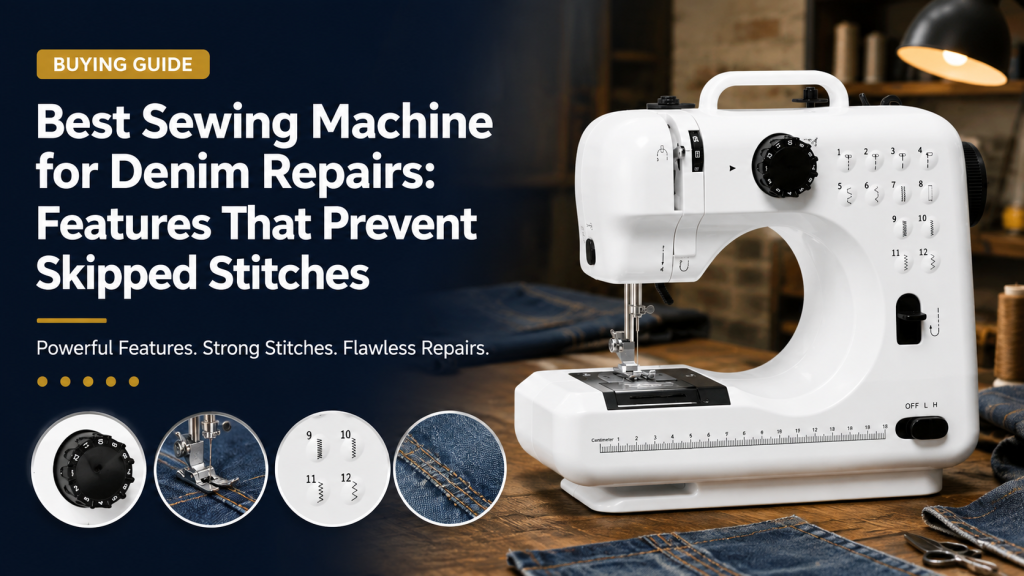
The best sewing machine for denim repairs is not simply the model with the largest motor claim. It is the machine that can start slowly, feed several layers evenly, penetrate a bulky seam without deflecting the needle, and keep its stitch formation stable when the thickness changes. This guide explains what to test before buying so routine jeans repairs do not become a cycle of broken needles, uneven feeding, and skipped stitches.
How To Choose The Best Sewing Machine For Denim Repairs
Denim repair work creates abrupt thickness changes. A machine may sew two flat layers cleanly but hesitate where a hem crosses a side seam or where a patch overlaps an original seam allowance. That is why maximum stitch speed matters less than predictable control at the first few stitches and the ability to maintain feeding as the presser foot climbs onto a ridge. For this decision, heavy duty sewing machine is useful context: This label should indicate a sturdier drive and frame, but the name alone does not prove smooth control on a crossed seam.
Think about the repairs you will perform most often. Shortening jeans requires controlled hemming and room under the foot; patching knees needs smooth directional control; replacing a zipper needs accurate edge stitching. A good purchase balances these real tasks with serviceability, available needles and feet, and a bobbin system you can monitor easily. For this decision, denim sewing tips is useful context: Good technique includes grading bulky allowances, using a height compensator, and testing thread and stitch length on an offcut.
Features That Keep Denim Stitches Consistent
Low-Speed Power And Pedal Control
Look for a machine that begins smoothly instead of jumping from stopped to fast. Controlled power lets the needle penetrate stacked denim while you guide the seam accurately. Electronic speed limiting is especially useful for beginners because it prevents sudden acceleration at a bulky junction. For this decision, needle for thick fabric is useful context: Choose a sharp, correctly sized jeans needle and replace it when it begins to deflect or produce inconsistent holes.
Feed Stability Over Changing Thickness
The feed dogs and foot must move the top and bottom layers together. Check whether the foot stays reasonably level when it reaches a raised seam. A leveling button, hump jumper, or compatible even-feed attachment can reduce short stitches and fabric drag at the transition. For this decision, presser foot pressure is useful context: Adjustment can improve feeding when a fixed setting either compresses the layers too much or allows them to shift.
Needle Clearance And Penetration
A rigid needle bar and correct needle plate opening help the needle enter straight. The machine should accept common jeans needles in suitable sizes, and the handwheel should turn through the thickest test stack without binding. Never force the wheel when the needle is deflecting. For this decision, skipped stitch prevention is useful context: Correct needle installation, suitable thread, stable feeding, and avoiding excessive needle deflection work together to protect stitch formation.
Presser-Foot Lift And Workspace
Extra lift creates room to position folded hems without scraping the fabric under the foot. Also check the space to the right of the needle, the visibility around the stitch line, and whether the free arm is narrow enough for trouser legs and cuffs.
Reverse, Stitch Length, And Service Access
A reliable reverse control secures repair seams without creating a thread nest. Useful stitch-length adjustment helps balance appearance and strength. Easy bobbin access, clear threading, and local access to replacement parts matter more over time than a long list of decorative stitches. For this decision, jeans hemming machine is useful context: A useful option should handle the folded hem, provide controlled reverse, and fit the trouser leg around its free arm.
A Practical Denim Test Before You Buy
- Prepare a sample with two flat layers, a four-layer fold, and one crossed seam that resembles a real jeans hem.
- Install the recommended jeans needle and use normal all-purpose or jeans thread rather than an unusually fine demonstration thread.
- Start from a complete stop on the thick section and listen for strain while watching whether the needle bends.
- Sew from a thin area onto the ridge and back down, then compare stitch length on both sides.
- Use reverse for three or four stitches and inspect the underside for loops, nesting, or uneven tension.
- Repeat at a controlled slow speed to confirm that the result was not dependent on momentum.
Keep the sample and note the exact needle, thread, stitch length, and foot used. That record is more useful than a showroom impression because it lets you reproduce the setup when the machine arrives. For this decision, strong motor sewing machine is useful context: Usable power is power delivered smoothly at low speed, not merely a high advertised top speed.
What Matters Most For Common Denim Repairs
| Repair task | Priority feature | Warning sign |
|---|---|---|
| Shortening jeans | Foot lift and slow control | Machine stalls at the crossed side seam |
| Knee patch | Even feeding and visibility | Patch creeps or puckers while turning |
| Zipper replacement | Accurate foot options | Needle position cannot align near zipper teeth |
| Pocket repair | Free-arm access | Garment cannot be positioned without twisting |
Mistakes That Cause Avoidable Skipped Stitches
- Using a dull universal needle for a dense folded seam.
- Pulling the fabric from behind, which bends the needle away from the hook.
- Starting with the presser foot tilted sharply on a ridge.
- Choosing a decorative thread before confirming basic stitch formation.
- Assuming maximum speed proves strength at a controlled repair pace.
When a machine skips only at a thickness transition, correct the setup first. If it skips on a flat test with the correct needle and threading, the timing, needle system, or machine condition may need professional inspection. If you want a broader comparison before buying, review Heavy-duty machine guide and compare its guidance with the setup discussed in this article.
Set Up A Repeatable Repair Workflow
Begin every repair by identifying the thickest point and planning the seam direction so the machine approaches it steadily. Grade hidden seam allowances when the garment construction permits, press the fold firmly, and hand-turn the first penetration if visibility is limited. A small leveling tool behind the foot can keep the foot parallel while it climbs. For a more specific setup check, use Needle and fabric matching guide to compare compatibility details, fabric behavior, or attachment limits before you order.
After sewing, inspect both sides under good light. Consistent stitch length, balanced tension, and clean needle holes matter more than speed. Save a small test swatch with the machine settings written on it; over several projects, this becomes a reliable reference for jeans weight, thread choice, and needle size. When you need a product example or a supporting tutorial, Singer 4452 product details gives you another reference point that fits naturally with this topic.
Choose The Best Sewing Machine For Denim Repairs With Confidence
The best sewing machine for denim repairs is the one that completes your thickest realistic sample at a slow, controlled pace with balanced stitches on both sides. Compare the whole system—needle, foot, feed, clearance, frame, and service support—rather than buying from a heavy-duty label alone. When comparing the best sewing machine for denim repairs, use the same test stack for every model before ordering. For manufacturer-level technical detail, also review the SCHMETZ sewing machine needle guide before changing settings, buying accessories, or troubleshooting a difficult seam.
Frequently Asked Questions
Can a regular home sewing machine repair jeans?
Yes, many full-size home machines can handle routine patches and hems when fitted with the correct jeans needle and used at a controlled speed. Very dense crossed seams may still require leveling, reduced bulk, or a more capable machine.
What needle size is suitable for denim repairs?
The correct size depends on denim weight and thread. Common jeans needle sizes include 90/14, 100/16, and 110/18, but always check the machine manual and test the smallest size that penetrates without deflection.
Why does a machine skip stitches only on the side seam?
The presser foot may tilt, feeding may slow, or the needle may deflect as it enters the ridge. Level the foot, use a fresh correct needle, reduce speed, and avoid pulling the garment.
Is a walking foot necessary for hemming jeans?
Not always. It can help when layers shift, but good feed dogs, correct foot pressure, and a leveling tool may be enough for a standard hem.
Should I use thicker thread for every jeans repair?
No. Very thick thread can exceed the needle or tension system the machine was designed for. Start with a quality thread compatible with the needle and use stronger topstitching thread only when the machine manual supports it.
