

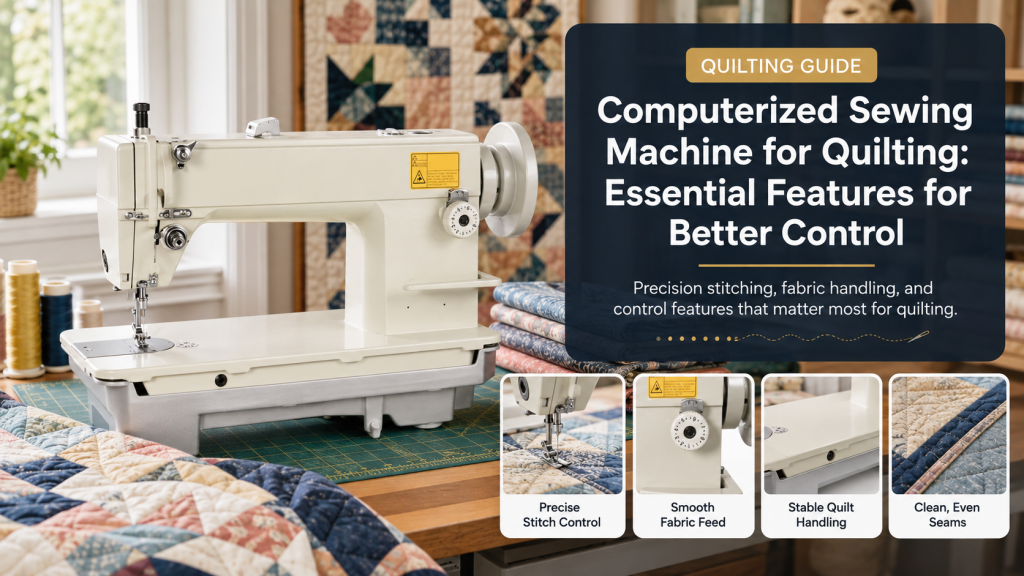
A computerized sewing machine for quilting should make fabric handling more predictable, not distract the quilter with a long decorative-stitch list. The features that matter most are the ones used repeatedly: controllable speed, programmable needle stop, stable straight-stitch feeding, adequate workspace, clear visibility, and a surface that supports the quilt’s weight. Automation can reduce hand movements, but only when the basic mechanical performance remains consistent across piecing, layered quilting, and binding.
Choose A Computerized Sewing Machine For Quilting Around Workflow
Quilting includes several different operations. Piecing needs accurate seam guides and repeatable quarter-inch results. Walking-foot quilting needs smooth layered feeding and physical support. Free-motion work needs responsive speed, appropriate foot options, and a machine that can lower or cover the feed dogs. Binding adds bulky edges and long continuous seams. For this decision, quilting stitch options is useful context: Useful choices may include reliable straight stitch, hand-look effects, applique stitches, and adjustable blanket stitches rather than hundreds of unrelated patterns.
A machine can be excellent at one stage and inconvenient at another. Test the complete sequence using the fabrics, batting, and thread you prefer. Pay attention to how often you must reach away from the quilt, whether controls remain accessible with a large project in place, and how easily the machine returns to a known straight-stitch setup. For this decision, needle up down function is useful context: A programmable stop position supports pivots, chain piecing, and controlled repositioning while the layers remain anchored.
Computerized Controls That Improve Quilting Accuracy
Programmable Needle Stop
Setting the needle to stop down anchors the quilt during broad turns, repositioning, and chain piecing. It reduces the need to tap the pedal or handwheel to find a safe pivot point. Check that the setting is easy to see and remains active as expected. For this decision, speed control sewing machine is useful context: A maximum-speed slider can make pedal control more forgiving and improve consistency during detailed work.
Adjustable Maximum Speed
A speed limiter lets the quilter press the pedal comfortably while keeping motion within a controlled range. This is useful for beginners, dense intersections, binding, and free-motion practice. The machine should still start smoothly at the lowest setting. For this decision, extension table is useful context: A level table supports the quilt near the needle and reduces the downward pull that can distort feeding.
Workspace And Visibility
Measure the usable distance to the right of the needle and the height under the arm. Good lighting, a clear needle plate, and uncluttered controls reduce fatigue. More space helps with larger quilts, but table support and project handling remain essential. For this decision, throat space for quilting is useful context: Usable width and height affect how much rolled or folded quilt can pass to the right of the needle.
Feeding And Foot Compatibility
Confirm access to a quarter-inch foot, open-toe option, walking attachment, and free-motion foot appropriate for the model. Test whether the feed stays consistent through seam intersections and whether pressure can be adjusted for different layers.
Convenience Without Lost Control
Thread trimming, start-stop buttons, lock stitches, and memory can save repeated movements. They should operate predictably and allow manual control when needed. An automatic function that leaves short tails or makes a bulky knot may not suit every quilting technique. For this decision, automatic thread cutter is useful context: A dependable cutter saves repeated reach, but test tail length and whether it suits chain piecing and decorative topstitching.
Test The Machine Through Four Quilting Operations
- Piece two blocks with a quarter-inch seam and verify seam consistency from start to finish.
- Cross a bulky intersection slowly and compare stitch length before, on, and after the ridge.
- Quilt a layered sample in straight rows using the intended walking attachment and table support.
- Lower or cover the feed dogs and test free-motion response at two controlled speed settings.
- Attach a binding sample and check visibility, foot lift, reverse or lock control, and access to buttons.
- Use the thread cutter and needle-stop settings repeatedly to confirm they behave consistently.
Bring a prepared sample sandwich when possible. Dealer fabric may be unusually easy to sew and will not reveal how the machine handles your preferred batting loft, dense seams, or thread combination. For this decision, quilting machine guide is useful context: A useful guide compares feeding, workspace, controls, included feet, service, and project scale rather than stitch count alone.
Feature Priority By Quilting Task
| Task | Highest priority | Helpful secondary feature |
|---|---|---|
| Accurate piecing | Stable feed and seam guide | Needle stop and cutter |
| Straight-line quilting | Layer feeding and table support | Speed limiter |
| Free-motion quilting | Smooth speed response and foot access | Needle-down setting |
| Binding | Foot lift and visibility | Lock stitch |
| Large quilts | Workspace and weight support | Accessible controls |
Features That Can Be Overvalued
- Choosing by decorative stitch count instead of straight-stitch consistency.
- Measuring machine width rather than usable space to the right of the needle.
- Assuming an included table is large enough to support the full project.
- Ignoring the price and availability of quilting feet for the exact model.
- Testing automation without checking whether it can be overridden for special techniques.
The best feature is one that removes a repeated interruption. Make a list of the hand movements and setup changes in your current quilting process, then test whether the new machine genuinely simplifies them. If you want a broader comparison before buying, review Quilting features guide and compare its guidance with the setup discussed in this article.
Configure A Repeatable Quilting Station
Level the machine bed with the surrounding table, place frequently used controls within reach, and support the quilt on the left and behind the needle. Save a standard piecing setup with needle, stitch length, foot, seam guide, and tension. Keep a separate sample for layered quilting and note any pressure or feed changes. For a more specific setup check, use Singer 9960 quilting machine to compare compatibility details, fabric behavior, or attachment limits before you order.
Use speed limits as training tools rather than permanent restrictions. As control improves, increase the range gradually while maintaining stitch consistency. Clean lint regularly because batting produces debris, replace needles before they begin to deflect, and verify the stitch underside whenever thread, batting, or technique changes. When you need a product example or a supporting tutorial, Juki TL-2000Qi quilting machine gives you another reference point that fits naturally with this topic.
Choose A Computerized Sewing Machine For Quilting Around Repeatable Control
A computerized sewing machine for quilting is a strong upgrade when its automation supports accurate fabric movement, comfortable handling, and fewer interruptions. Put workspace, feeding, speed control, needle stop, table support, and compatible feet ahead of decorative totals, then test the machine through the complete quilting workflow. A computerized sewing machine for quilting should make speed, needle position, feeding, and workspace easier to control in every session. For manufacturer-level technical detail, also review Singer’s quilting-machine collection before changing settings, buying accessories, or troubleshooting a difficult seam.
Frequently Asked Questions
How much throat space is enough for quilting?
It depends on quilt size and handling method. More space helps, but a supported table, good rolling or puddling technique, and accessible controls are equally important. Test a realistic bundle in the machine.
Is a computerized machine better than a mechanical machine for quilting?
Computerized controls can add speed limiting, programmable needle stop, trimming, and precise stitch selection. A well-built mechanical machine may still quilt very well if its feeding, workspace, and control suit the user.
Do I need an automatic thread cutter?
No, but a reliable cutter can save time on repeated operations. Check tail length and make sure manual trimming remains convenient for techniques where long tails are required.
Can one machine handle piecing and free-motion quilting?
Many can, provided they support suitable feet, feed-dog control, responsive speed, and adequate workspace. Test both operations because strengths in piecing do not guarantee comfortable free-motion handling.
Is an extension table necessary?
It is not mandatory, but a level support surface reduces drag close to the needle. Large quilts still need additional table or room support beyond the small included extension.
