

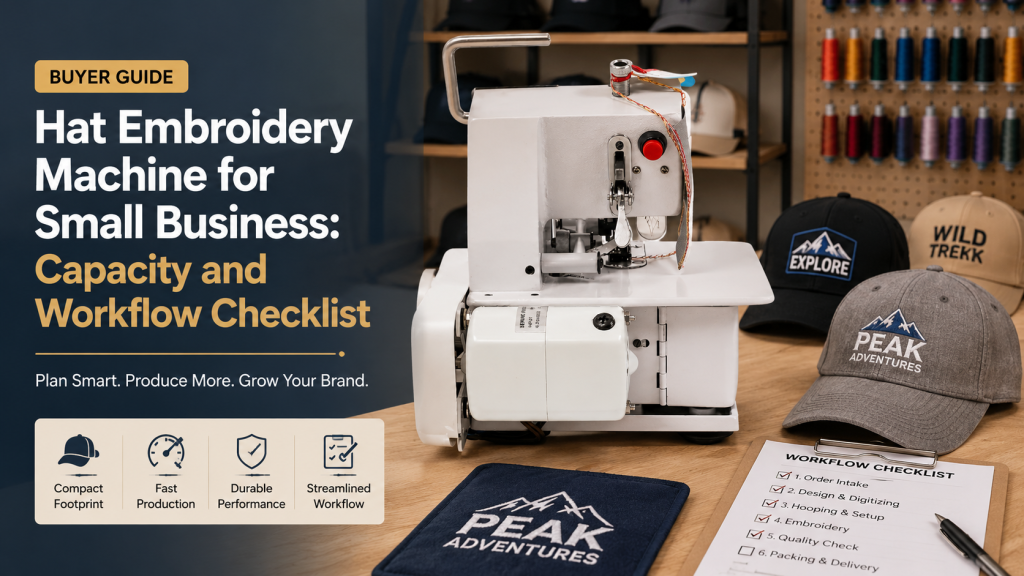
A hat embroidery machine for small business must handle more than a flat logo sample. Finished caps have curved fronts, seams, sweatbands, changing structure, and limited clearance near the bill. Profitable production depends on a compatible cap driver and frame, suitable free-arm access, cap-aware digitizing, repeatable hooping, color capacity, operator control, and fast recovery from thread breaks. The number of needles and maximum speed matter, but consistent placement and low reject rates matter more.
Define Capacity Before Buying A Hat Embroidery Machine For Small Business
Start with expected order size, logo width, number of colors, cap styles, turnaround time, and daily order mix. A six-needle machine may suit modest custom orders, while higher needle counts reduce rethreading for complex color palettes. Multiple heads improve volume only when sales, hooping labor, quality control, and space can support them. For this decision, cap embroidery equipment is useful context: The system includes the machine, cap driver, frames, gauge, stand, software, hoops, thread, stabilizer, and finishing tools.
Cap structure changes the result. Structured front panels, unstructured caps, performance fabric, foam fronts, and low-profile shapes need different hooping pressure, stabilizer, needle, and digitizing. Ask for live stitch-outs on the cap types you expect to sell rather than evaluating only flat fabric. For this decision, multi needle embroidery machine is useful context: Multiple needles keep colors ready and reduce rethreading, but they do not replace good hooping, digitizing, or service.
Production Features That Protect Quality And Margin
Cap Frame, Driver, And Sewing Field
Confirm the included system, maximum cap field, rotation range, supported cap styles, and setup time. A cap frame should hold the sweatband and front panel consistently without distorting the crown. Extra frames allow one cap to be prepared while another stitches. For this decision, commercial embroidery setup is useful context: Plan power, stand stability, thread storage, cap preparation, computer workflow, quality control, maintenance, and blank inventory.
Needle Count And Color Workflow
More needles keep common colors threaded and reduce manual changes. Map typical customer logos to the available needle count and consider thread inventory. Automatic color sequencing is useful only when tension, threading, and color order are managed reliably. For this decision, hat hoop attachment is useful context: Verify whether it stitches finished structured caps, the available field, rotation, frame count, and exact machine compatibility.
Low-Speed Control And Thread Detection
Caps often stitch better below the machine’s maximum speed, especially near seams and the bill. Smooth control, thread-break sensors, easy restart, and precise trace functions reduce rejects. Test recovery after an intentional thread break. For this decision, embroidery production speed is useful context: Measure complete minutes per approved cap, including hooping, tracing, color changes, trimming, inspection, and rework.
Digitizing And Lettering Quality
Cap designs are commonly sequenced from the center outward to reduce registration distortion. Small lettering, dense fills, and seam-crossing elements need appropriate underlay, pull compensation, and stitch direction. Poor digitizing cannot be fixed by machine speed.
Training, Service, And Operating Space
Budget for installation, cap-system training, software, stands, hoops, thread, backing, maintenance, and ventilation. Local service and parts availability protect deadlines. Plan enough room to hoop caps, store blanks, trim finished work, and inspect orders. For this decision, custom cap business is useful context: Profit depends on product positioning, blank cost, digitizing, minimum order, personalization time, reject allowance, and sales volume.
Run A Seller Demonstration Like A Real Order
- Provide two structured and two unstructured caps similar to the blanks you plan to stock.
- Use a real logo with small lettering, multiple colors, and at least one seam-adjacent element.
- Time cap hooping, design loading, tracing, color assignment, stitching, trimming, and inspection.
- Intentionally create a thread break and test sensor response and accurate restart.
- Repeat the same design on three caps and compare placement, registration, and distortion.
- Inspect the inside for backing, thread nests, rough trimming, and comfort.
- Calculate usable caps per hour from the complete cycle and include one realistic reject allowance.
Save the approved stitch file, exact cap model, hooping method, backing, needle, thread, speed, and tension notes. A successful sample on one cap style does not automatically transfer to every crown shape. For this decision, machine workflow is useful context: A commercial model should support repeatable design transfer, color assignment, tracing, positioning, stitch monitoring, and restart.
Capacity Measures That Matter
| Metric | Why it matters | How to verify |
|---|---|---|
| Maximum cap field | Limits logo size and placement | Manual and live trace |
| Needle count | Reduces color rethreading | Map typical logo colors |
| Complete cycle time | Determines real output | Time hoop-to-inspection |
| Thread-break recovery | Reduces rejects | Intentional break test |
| Repeat placement | Protects brand quality | Three-cap repeat run |
| Service response | Protects deadlines | Local references and parts plan |
Business Purchases That Inflate Payback Time
- Buying from advertised stitches per minute without timing hooping and finishing.
- Assuming every cap frame handles structured and low-profile caps equally.
- Using flat-garment digitizing on a curved cap without adjustment.
- Underpricing one-off personalization and revision time.
- Buying a multi-head system before sales consistently fill one head.
Start with a capacity model based on conservative orders. Add needles, frames, shifts, or additional heads only when a measured bottleneck and reliable demand support the next investment. If you want a broader comparison before buying, review BAI hat embroidery machine and compare its guidance with the setup discussed in this article.
Design A Repeatable Cap Order Process
Standardize a small blank catalog, record hoop settings for each style, and create approved placement templates. Require customers to approve size, position, colors, and a digital proof before production. Stitch one first article, inspect it, and obtain approval for larger or unfamiliar orders. For a more specific setup check, use 15-needle embroidery machine to compare compatibility details, fabric behavior, or attachment limits before you order.
Group orders by thread palette and cap style, stage blanks in sequence, and hoop the next cap while the machine runs when staffing permits. Track thread breaks, rejects, cycle time, and causes. That record reveals whether training, digitizing, maintenance, or additional equipment will improve margin most. When you need a product example or a supporting tutorial, Multi-needle embroidery option gives you another reference point that fits naturally with this topic.
Choose A Hat Embroidery Machine For Small Business Around Repeatable Output
The right hat embroidery machine for small business combines a proven cap system, suitable needle capacity, cap-aware digitizing, controllable stitching, reliable restart, service support, and an efficient preparation station. Time the full order workflow on real caps and calculate payback from approved sellable pieces, not theoretical machine speed. A hat embroidery machine for small business should deliver consistent cap placement, manageable color changes, and predictable order time. For manufacturer-level technical detail, also review Brother’s PR680W commercial embroidery information before changing settings, buying accessories, or troubleshooting a difficult seam.
Frequently Asked Questions
Do I need a multi-needle machine to embroider hats?
For regular finished-cap business work, a commercial multi-needle free-arm machine with a supported cap system is usually the practical choice. Flat single-needle machines may handle some unstructured items or panels before assembly.
How many needles are enough for a small cap business?
It depends on typical logo colors and order volume. Six needles can suit many custom jobs, while ten or fifteen reduce rethreading and support broader palettes. Workflow and service matter as much as count.
Why does embroidery shift around the center seam?
Cap curvature, poor hooping, excessive speed, dense digitizing, and stitch direction can distort registration. Cap designs are often digitized to sew from the center outward.
How fast can a hat embroidery machine produce caps?
Use complete cycle time rather than maximum stitches per minute. Include hooping, tracing, color setup, stitching, trimming, inspection, and realistic rework.
Should I buy a multi-head machine first?
Usually only when consistent demand, staffing, space, and sales already justify parallel output. A well-utilized single head is often the safer starting point.
