

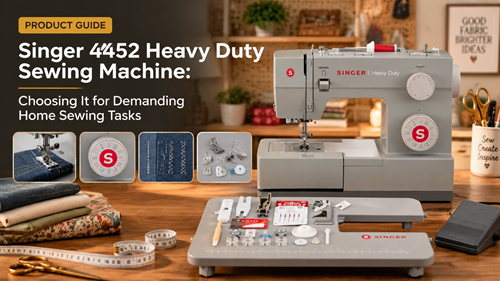
The Singer 4452 Heavy Duty Sewing Machine should be judged by the work it will do in a real sewing or embroidery space, not by a feature list alone. This guide is written for DIY makers who regularly sew utility fabrics, repairs, and multi-layer home projects. It focuses on project fit, setup, workflow, material handling, repeatability, and the practical checks that prevent a machine from becoming an expensive mismatch. SINGER lists the 4452 with a heavy-duty metal frame, extra power for thick fabrics, high sewing speed, 110 stitch applications, adjustable presser-foot pressure and specialty accessories including an even-feed foot and non-stick foot in the current package. Buyers should still test the exact material stack they plan to sew.
How To Evaluate The Singer 4452 Heavy Duty Sewing Machine
Start with the project list rather than the machine label. Write down the fabrics, finished sizes, seam or embroidery demands, accessories, and weekly volume you expect during the next six months. A model can be excellent in its intended role and still be the wrong purchase when the real work falls outside that role.
SINGER lists the 4452 with a heavy-duty metal frame, extra power for thick fabrics, high sewing speed, 110 stitch applications, adjustable presser-foot pressure and specialty accessories including an even-feed foot and non-stick foot in the current package. Buyers should still test the exact material stack they plan to sew.
Use this 4452 heavy fabric projects as a practical reference point, then compare it with the exact material, hoop, seam or workstation demands of your own projects.
A useful second check is robust home sewing setup because it helps place the machine inside a broader workflow rather than treating one product page as the entire buying decision.
Features And Setup That Matter In Real Use
Separate Piercing Power from Seam Management
A machine can penetrate a material yet still struggle when layers shift or a foot climbs a ridge. Plan feeding, foot choice and seam grading along with needle strength.
Use Specialty Feet for the Material Problem
An even-feed foot helps control multiple layers, while a non-stick foot can improve movement on some coated surfaces. Choose the foot because of fabric behavior, not because it came in the box.
Prepare Layered Seams Before Sewing
Trim hidden allowances, flatten bulky transitions and use a leveling aid where appropriate. Reducing unnecessary bulk protects stitch consistency and the needle.
Keep Heavy-Duty Expectations Domestic
The 4452 is a heavy-duty home machine, not a replacement for every industrial task. Repeated production on very dense materials may call for a purpose-built industrial setup.
Build A Repeatable Workflow Before You Buy
Plan layered seam sewing preparation around a real sample instead of a showroom demonstration. Measure or mark the critical dimensions first and keep a written record of the setup that produced the best result.
For utility sewing machine choice choose two or three representative projects and run them from preparation through finishing. The goal is to discover where setup time, workspace, feeding, hooping or file handling slows the process.
Keep a small reference notebook or digital note for successful combinations of needle, thread, foot or hoop, stabilizer, tension, stitch settings, and placement measurements. Repeating a known setup is faster and more reliable than rediscovering it for every project.
Run A Practical Test Before Committing
- Create a sample stack using the exact utility fabric and seam folds you expect to sew.
- Fit the correct needle and thread combination and choose the appropriate presser foot.
- Start at low speed on the thickest area instead of using momentum.
- Cross a seam ridge and inspect stitch length on both sides.
- Try reverse and cornering while the material is still layered.
- Save the sample and settings as a reference for future heavy projects.
A good test should be difficult enough to reveal the machine’s limits but representative enough to matter. Do not base the decision on a demo material, speed setting, or design that is easier than the projects you plan to make at home or in a small business.
Project Fit At A Glance
| Project Or Use | Fit | What To Check |
|---|---|---|
| Denim repair | Strong fit with correct setup | Crossed seams need leveling |
| Canvas bag | Good fit | Manage corner bulk |
| Vinyl project | Possible with suitable foot | Test surface feeding |
| Continuous industrial production | Not the intended role | Consider a dedicated industrial machine |
Turn The Feature List Into A Buyer Checklist
Use a Singer 4452 buyer questions that covers the exact bundle, accessories, consumables, workspace, support, and material or design limits you will depend on after purchase.
Your durable project workflow should also include storage, cleanup, repeat setup, and the time needed to prepare the next project. A machine that fits the whole routine is more valuable than one that only performs well during a short demo.
Compare the current seller listing with the manufacturer information before payment. Packages, included feet, hoops, software, tables, motors, colors, and accessories can change, so the model name alone is not enough to prove that two listings are identical.
Common Buying And Setup Mistakes
- Equating maximum speed with low-speed control
- Using one needle for every heavy fabric
- Skipping seam grading at bulky corners
- Pulling layers from behind the foot
- Assuming domestic heavy-duty means industrial duty cycle
When a test result is disappointing, change one variable at a time. Re-thread, verify the needle or design file, confirm the foot or hoop, and repeat the same sample. That approach separates a setup problem from a true machine limitation.
Verify The Current Manufacturer Information
Before ordering, review the manufacturer information for Singer 4452 Heavy Duty Sewing Machine. Use the current manual and support material as the final authority for specifications, compatible accessories, setup steps, safety, maintenance, and any model-specific limitations.
Choose The Singer 4452 Heavy Duty Sewing Machine For The Work You Actually Do
The Singer 4452 Heavy Duty Sewing Machine makes the most sense when its strongest workflow aligns with utility repairs, denim, canvas, vinyl with appropriate accessories, bags, home-decor layers, workwear alterations, and makers who want a domestic machine with a stronger mechanical focus. A careful buyer should be able to describe the first several projects, the workspace, the accessories or files required, and the hardest realistic test before clicking buy.
Use that test-first approach and the Singer 4452 Heavy Duty Sewing Machine becomes easier to evaluate on practical evidence rather than marketing language. The best choice is the machine that produces repeatable results with a setup you are willing to use every week.
Frequently Asked Questions
What makes the Singer 4452 different from a basic home machine?
SINGER markets it around a heavy-duty frame, extra power, high speed and a package of accessories intended for a wider range of materials.
Can it sew denim and canvas?
It is marketed for heavy-duty projects including denim and canvas, but seam thickness, needle, thread and feeding setup still matter.
Does it include an even-feed foot?
SINGER currently lists an even-feed or walking foot among the included 4452 accessories.
Is the 4452 industrial?
No. It is a domestic heavy-duty machine, not a dedicated industrial production head.
What should I test before buying?
Use the thickest realistic project sample, especially folded crossings and corners, and evaluate control at low speed.
