

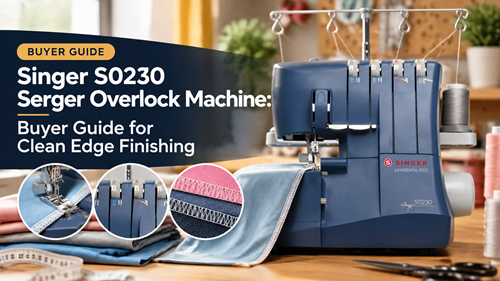
The Singer S0230 Serger Overlock Machine should be judged by the work it will do in a real sewing or embroidery space, not by a feature list alone. This guide is written for garment sewists wanting faster seam finishing and cleaner fabric edges at home. It focuses on project fit, setup, workflow, material handling, repeatability, and the practical checks that prevent a machine from becoming an expensive mismatch. SINGER lists the S0230 with 2-, 3- and 4-thread stitch capability, differential feed, a built-in free arm and speeds up to 1,300 stitches per minute. The real learning curve is threading, balancing tension and matching differential feed to the fabric.
How To Evaluate The Singer S0230 Serger Overlock Machine
Start with the project list rather than the machine label. Write down the fabrics, finished sizes, seam or embroidery demands, accessories, and weekly volume you expect during the next six months. A model can be excellent in its intended role and still be the wrong purchase when the real work falls outside that role.
SINGER lists the S0230 with 2-, 3- and 4-thread stitch capability, differential feed, a built-in free arm and speeds up to 1,300 stitches per minute. The real learning curve is threading, balancing tension and matching differential feed to the fabric.
Use this S0230 edge finishing guide as a practical reference point, then compare it with the exact material, hoop, seam or workstation demands of your own projects.
A useful second check is overlock seam planning because it helps place the machine inside a broader workflow rather than treating one product page as the entire buying decision.
Features And Setup That Matter In Real Use
Learn the Thread Path Before Chasing Speed
A serger becomes much easier when each thread path is understood separately. Follow the color-coded order and rethread from the beginning when a chain suddenly changes.
Use Differential Feed as a Fabric Tool
Differential feed can help reduce waviness on stretchy fabric or puckering on light fabric. Test small changes on scraps rather than treating one setting as universal.
Plan Seam Allowance Before the Knife
The cutting blade removes fabric, so the seam position must be planned before you feed the garment. Practice on marked scraps until the knife removes only the intended allowance.
Keep a Reference Sample for Each Fabric Type
Save a small swatch with thread colors, differential setting, stitch length and tension notes. That turns future setup into a repeatable process instead of trial and error.
Build A Repeatable Workflow Before You Buy
Plan knit garment edge control around a real sample instead of a showroom demonstration. Measure or mark the critical dimensions first and keep a written record of the setup that produced the best result.
For serger thread workflow choose two or three representative projects and run them from preparation through finishing. The goal is to discover where setup time, workspace, feeding, hooping or file handling slows the process.
Keep a small reference notebook or digital note for successful combinations of needle, thread, foot or hoop, stabilizer, tension, stitch settings, and placement measurements. Repeating a known setup is faster and more reliable than rediscovering it for every project.
Run A Practical Test Before Committing
- Thread all planned positions using contrasting thread colors.
- Sew a stable woven sample and confirm the stitch forms cleanly at the edge.
- Move to a knit sample and adjust differential feed only as needed.
- Check that the knife trims a controlled amount of seam allowance.
- Try the free arm on a small tube such as a sleeve sample.
- Save the successful settings with the fabric swatch.
A good test should be difficult enough to reveal the machine’s limits but representative enough to matter. Do not base the decision on a demo material, speed setting, or design that is easier than the projects you plan to make at home or in a small business.
Project Fit At A Glance
| Project Or Use | Fit | What To Check |
|---|---|---|
| T-shirt side seam | 4-thread overlock | Watch stretch recovery |
| Woven seam finish | 3-thread finish | Do not trim too much |
| Sleeve or cuff | Free-arm access | Keep tube clear of moving parts |
| Light knit edge | Differential feed | Avoid waviness |
Turn The Feature List Into A Buyer Checklist
Use a home overlocking projects that covers the exact bundle, accessories, consumables, workspace, support, and material or design limits you will depend on after purchase.
Your Singer S0230 purchase checklist should also include storage, cleanup, repeat setup, and the time needed to prepare the next project. A machine that fits the whole routine is more valuable than one that only performs well during a short demo.
Compare the current seller listing with the manufacturer information before payment. Packages, included feet, hoops, software, tables, motors, colors, and accessories can change, so the model name alone is not enough to prove that two listings are identical.
Common Buying And Setup Mistakes
- Rethreading only one lower looper after a break
- Ignoring the threading order
- Cutting too much seam allowance on the first pass
- Changing several tensions at once
- Serging a finished garment before testing the fabric
When a test result is disappointing, change one variable at a time. Re-thread, verify the needle or design file, confirm the foot or hoop, and repeat the same sample. That approach separates a setup problem from a true machine limitation.
Verify The Current Manufacturer Information
Before ordering, review the manufacturer information for Singer S0230 Serger Overlock Machine. Use the current manual and support material as the final authority for specifications, compatible accessories, setup steps, safety, maintenance, and any model-specific limitations.
Choose The Singer S0230 Serger Overlock Machine For The Work You Actually Do
The Singer S0230 Serger Overlock Machine makes the most sense when its strongest workflow aligns with knit garments, seam finishing, rolled or narrow edge work supported by the machine, children’s clothing, casual apparel, and home sewists who want trimming plus overlocking in one pass. A careful buyer should be able to describe the first several projects, the workspace, the accessories or files required, and the hardest realistic test before clicking buy.
Use that test-first approach and the Singer S0230 Serger Overlock Machine becomes easier to evaluate on practical evidence rather than marketing language. The best choice is the machine that produces repeatable results with a setup you are willing to use every week.
Frequently Asked Questions
Can the Singer S0230 sew knits?
Yes, its differential feed and overlock stitches are intended for many stretch-fabric workflows, but settings should be tested on the actual knit.
How many threads can the S0230 use?
SINGER lists 2-, 3- and 4-thread stitch combinations.
Does a serger replace a regular sewing machine?
Not completely. A serger excels at edge finishing and stretch seams, while a conventional machine remains useful for construction details, topstitching, buttonholes and other tasks.
What does differential feed do?
It changes the relative fabric feed to help control stretching or puckering as the fabric passes through the machine.
What is the best first practice?
Thread with contrasting colors and test on scrap so you can see which thread controls each part of the stitch.
